
Home > Welded Tubes > Heat Exchanger Tubes (A249 / B516 / EN 10217-7)
INOX STEEL INDIA supplies high-performance Heat Exchanger Tubes designed for consistent heat transfer, long service life, and dependable operation in demanding industrial environments.
Heat exchanger tubing is selected when systems must move heat safely between fluids—often under continuous thermal cycling, pressure variation, and corrosive exposure. That’s why these tubes are widely used in refineries, petrochemical plants, power stations, chemical industries, HVAC & chiller systems, marine cooling circuits, and industrial heat recovery units.
Unlike general-purpose tubing, heat exchanger tubes must deliver two things at the same time:
To meet those needs, we supply heat exchanger tubes as per global, application-proven standards:
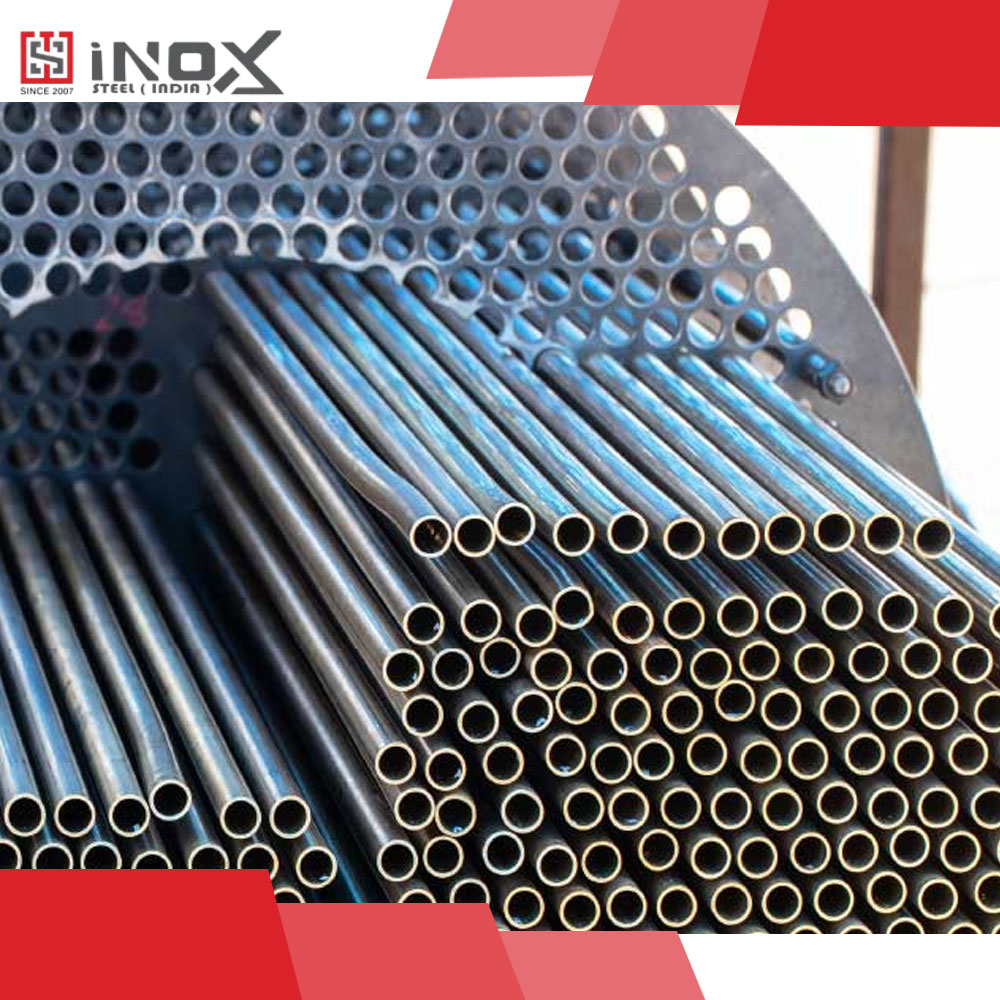
In most plants, exchanger performance directly affects:
A tube that pits, scales heavily, cracks due to thermal cycling, or fails at the weld can shut down the system. That’s why buyers specify heat exchanger tubes based on service media, temperature, chloride exposure, and design pressure—not only by size.
INOX STEEL INDIA supports this application with a practical, project-ready supply approach: correct grade selection, clean tubing, consistent weld quality, and documentation readiness for EPC and plant maintenance teams.
Heat exchanger tubes are not selected by size alone. Engineers choose them based on how the tube will behave over years of exposure to heat, pressure, flow velocity, and corrosive media. The wrong material can lead to fouling, pitting, weld failure, or repeated shutdowns.
This is where the correct standard–material combination becomes critical.
🔹 Stainless Steel Heat Exchanger Tubes — ASTM A249
ASTM A249 is the most widely used standard for stainless steel welded heat exchanger and condenser tubes. These tubes are preferred where fluids are moderately corrosive and operating temperatures are stable to moderately high.
They are commonly used in:
Why ASTM A249 is preferred
In refinery, chemical, and power plant environments, A249 tubes provide an excellent balance between performance, availability, and lifecycle cost.
🔹 Nickel Alloy Heat Exchanger Tubes — ASTM B516
When operating conditions exceed the limits of stainless steel, ASTM B516 nickel alloy welded tubes are selected.
These are used in environments involving:
Nickel alloy tubes are commonly specified for:
Why ASTM B516 is chosen
Nickel alloys maintain strength and corrosion resistance even when exposed to conditions that rapidly degrade stainless steel. This makes them ideal for critical heat transfer systems where failure is not an option.
🔹 Pressure-Grade Heat Exchanger Tubes — EN 10217-7
For projects governed by European design codes, heat exchanger tubes are often specified as per EN 10217-7.
These tubes are selected when:
They are widely used in:
Why EN 10217-7 matters
It combines corrosion resistance with defined mechanical properties and pressure suitability, making it ideal for heat exchangers operating within regulated pressure systems.
Across industries, heat exchanger tubes perform different roles:
In each case, the choice of standard is driven by service conditions, not by price alone.
Engineers typically evaluate:
This selection logic is what ensures long exchanger life, stable efficiency, and minimal unplanned shutdowns.
INOX STEEL INDIA supports buyers at this stage by aligning material selection with real operating conditions, rather than offering a one-grade-fits-all approach.
In heat exchanger systems, tube quality directly impacts thermal efficiency, plant uptime, and maintenance cycles. Even minor inconsistencies in weld quality or surface condition can lead to fouling, localized corrosion, or premature leakage.
For this reason, heat exchanger tubes supplied by INOX STEEL INDIA are produced with a strong focus on:
Each tube supplied for heat exchanger service is intended to perform reliably under continuous thermal cycling, fluctuating flow rates, and long-term exposure to process media.
Buyers choose INOX STEEL INDIA not only for product availability, but for application understanding.
Our role is not just to supply tubes, but to ensure the right tube performs in the right exchanger environment.

Heat exchanger tubes supplied under ASTM A249, ASTM B516, and EN 10217-7 are widely used in:
This wide acceptance makes them a reliable choice for both domestic installations and export equipment.
For heat exchanger, condenser, and industrial heat-transfer applications:
52-A, Mulji Thackersi Bldg, Islampura Street, Shop No. 10, Near Alankar Cinema, Mumbai – 400 004
alloy@inoxsteelindia.in, steel@inoxsteelindia.in
+91 9930796690
Stainless steel welded tubes as per ASTM A249, nickel alloy welded tubes as per ASTM B516, and EN 10217-7 pressure-grade stainless tubes are commonly used.
Yes. These standards are specifically designed for welded heat exchanger and condenser applications.
Nickel alloy tubes are used where temperatures are high or fluids are highly corrosive and stainless steel performance may be limited.
EN 10217-7 is commonly specified in European EPC and pressure-regulated systems.
INOX STEEL INDIA supplies heat exchanger tubes as per ASTM A249, ASTM B516 and EN 10217-7 standards. Stainless steel and nickel alloy welded tubes suitable for power plants, refineries, chemical industries and HVAC heat-transfer systems.
WhatsApp us